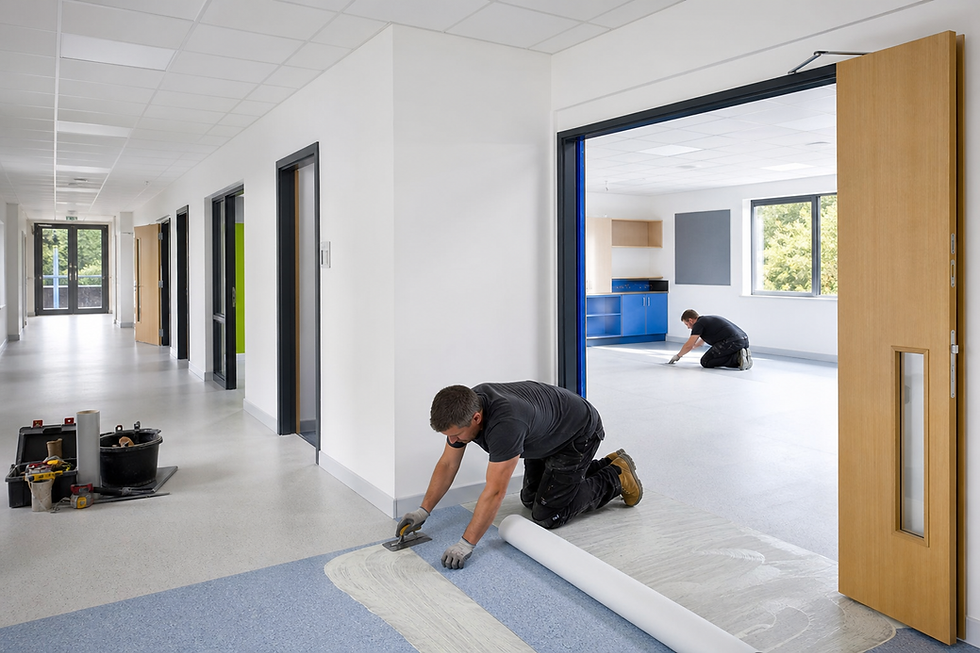
Commercial Vinyl Flooring Replacement: What to Consider Before A Refurbishment

Commercial vinyl flooring is designed to cope with busy environments, but it will not last indefinitely. Heavy footfall, wheeled traffic, moisture, changes in use and the condition of the subfloor can all affect its performance over time.
When vinyl flooring is damaged or has reached the end of its practical service life, repairs are not generally carried out in commercial environments. Standard practice is usually to replace the affected area so the new installation can achieve a level, secure and consistent finish.
Planning that replacement before refurbishment begins can help avoid delays, unexpected preparation work and disruption later in the programme. At Hilcrest Flooring Solutions Ltd, we support commercial flooring projects, working with clients across the UK.
This guide explains the main points to consider when planning commercial vinyl flooring replacement as part of a refurbishment.
Why damaged commercial vinyl is usually replaced
Vinyl flooring forms part of a complete sealed, waterproof flooring system. Its performance depends not only on the visible finish but also on the integrity of the welded joints, the adhesive and the subfloor beneath it.
Trying to repair a damaged vinyl surface may not provide the level or consistent result required in a commercial setting. Replacing the affected section allows the existing material to be removed, the area beneath it to be assessed and the new flooring to be installed correctly in accordance with BS 8203:2017.
The exact replacement scope will depend on factors such as:
The type of vinyl being installed
The size and location of the affected area
The condition of the surrounding flooring
The condition of the subfloor
The intended use of the space after refurbishment
In some cases, a defined section can be replaced. In others, replacing a larger area or the entire room may provide the better result, particularly where the existing material is worn, discontinued or no longer suitable for the space.
Signs that commercial vinyl flooring may need replacement
Lifting, bubbling or loose areas
Vinyl that has lifted or formed bubbles may present a safety concern and can make cleaning more difficult. These symptoms can also point to an issue beneath the surface, so the cause should be assessed before new flooring is installed.
Splits, tears or damaged joints
Damage to the surface or joints can allow dirt and moisture to collect where vinyl welds have failed. In hygiene-sensitive spaces, such damage can lead to a breach of infection control.
Widespread wear or permanent marking
Entrances, corridors, reception areas and other high-traffic zones often show wear first. Where the surface is extensively worn or cannot be restored through appropriate cleaning, replacement may be the most practical way to achieve a professional finish.
An uneven or unstable finish
If the flooring feels uneven, moves underfoot or reflects imperfections from below, the issue may relate to the subfloor or earlier preparation work. Simply covering the surface without addressing the cause can compromise the new installation, affect the life of the new flooring, lead to further costs and void manufacturer warranties.
A change in how the space will be used
Refurbishment often changes the demands placed on a floor. New traffic levels, cleaning routines, slip-resistance requirements or design expectations may mean the existing vinyl is no longer the right specification, even if it has not completely failed.
Start with a floor survey
A floor survey provides a clearer picture of the existing installation before the refurbishment scope is finalised. It can help establish what material is present, how much needs to be removed and what preparation may be required to meet warranty requirements, support the flooring's full life expectancy and comply with BS 8203:2017.
The survey should consider:
The condition of the vinyl across the full area
Whether defects are isolated or repeated
Floor surface regularity and visible changes in the surface
The condition of joints, edges and transitions
Access restrictions and occupied areas
The likely condition of the substrate
The new flooring specification and intended use
This information helps the flooring work align with the wider refurbishment programme. Most subfloor defects are apparent at the point of survey, reducing the risk of important preparation requirements only becoming clear after the old floor has been uplifted.
Subfloor preparation is essential
The finished floor can only perform as well as the surface beneath it. Once the existing vinyl is removed, the subfloor may need work before a replacement can be laid.
Depending on its condition, preparation may include removing adhesive residues or contamination, addressing uneven areas and applying an appropriate smoothing compound. Moisture testing or other checks may also be required for the particular site and flooring system.
This stage should not be rushed. Good subfloor preparation supports:
A smooth appearance
Secure adhesion of the new vinyl
Better performance in regular commercial use
Clean transitions at doorways and adjoining finishes
BS 8203:2017 compliance
Allowing time for preparation in the programme is particularly important when several trades are working in the same area.
Choose a vinyl specification for the space
Replacement is an opportunity to check whether the flooring still suits the building and its users. The right specification will depend on the environment rather than appearance alone and should account for any relevant changes to building regulations.
Points to consider include:
Expected footfall and wheeled traffic
Cleaning and maintenance requirements
Slip resistance and safety needs
Hygiene requirements
Comfort and acoustic considerations
Colour, pattern and the wider interior scheme
Junctions with carpet tiles, entrance flooring or other finishes
Commercial offices, shops, schools, healthcare settings, hospitality venues and public buildings can all place different demands on a floor. Early product selection allows availability, lead times and installation requirements to be considered before work starts.
Plan access and phasing before installation
Floor replacement affects how people move through a building. The area will need to be cleared and free of other trades before the existing flooring is uplifted, the subfloor is prepared and the new finish is given the conditions it needs for installation.
On an occupied site, the work may need to be completed in phases or outside normal operating hours. Corridors, entrances, clinical areas, classrooms and retail spaces can require particularly careful planning because they may be difficult to take out of use.
Before agreeing the programme, consider:
When furniture, fixtures or equipment can be moved
How alternative access routes will be managed
Which other trades need to finish first
The time required for preparation materials and adhesives
When the new floor can be opened to normal traffic
How waste and uplifted materials will leave the site
A realistic sequence protects the installation and helps reduce disruption for staff, visitors and customers.
Think about appearance across the whole area
Replacing a section of vinyl does not always produce an invisible match. Existing flooring may have changed through wear, cleaning or exposure to light, while the original product may no longer be available.
Where appearance matters, it may be better to replace up to a natural break such as a doorway, threshold or change of room. This can create a more intentional finish than introducing a new section in the middle of a continuous area.
The decision should balance condition, product availability, budget and the standard expected at handover.
Commercial vinyl replacement and dilapidation works
Flooring can also be an important part of end-of-lease or dilapidation works. The required scope will depend on the lease obligations.
An early assessment can help determine whether worn or damaged vinyl needs to be removed and replaced, and whether subfloor work should be allowed for. Establishing this before other finishes are completed can prevent duplication and last-minute changes.
A custom-made scope of works and bill of quantities for your flooring project will support like-for-like quotes from multiple companies, helping to avoid hidden costs or missed items.
How Hilcrest Flooring Solutions Ltd can help
Hilcrest Flooring Solutions Ltd is a commercial flooring contractor supporting projects across the UK. We work with clients across offices, retail, education, healthcare, hospitality and public buildings.
Our services include commercial flooring installation, floor surveys and consultancy, subfloor preparation and support for dilapidation projects. We can assess the existing floor, help define the replacement scope and recommend a flooring solution suited to the building, use and programme.
By involving an industry-trained, certified flooring specialist early, clients can plan the uplift, preparation and installation as one coordinated part of the refurbishment, rather than starting the project without a clear understanding of the cost or time required to complete the works.
Plan your commercial vinyl flooring replacement
If existing vinyl flooring is worn, damaged or no longer suitable, planning its replacement early can make the wider refurbishment run more smoothly.
The right approach starts with understanding the condition of the full flooring system, then allowing for appropriate preparation, product selection and installation time.
To discuss a commercial vinyl flooring replacement project, contact Hilcrest Flooring Solutions Ltd on 0116 271 5550, email info@hilcrestflooringltd.com or visit www.hilcrestflooringltd.com.
Frequently asked questions
Can damaged commercial vinyl flooring be repaired?
Repairs are not generally carried out on vinyl flooring in commercial environments. The usual approach is to replace the affected area so the substrate can be checked and a level, secure finish can be achieved.
Does the whole commercial floor need to be replaced?
Not necessarily. The appropriate scope depends on the product, the extent of the damage, the condition of the surrounding flooring and whether a suitable match is available. A floor survey can help determine whether a section, room or wider area should be replaced.
Why is subfloor preparation important when replacing vinyl?
Vinyl needs a suitable, smooth and stable base. Unevenness, residue, contamination or moisture-related issues can affect the appearance, performance and warranty of the new floor.
Can commercial vinyl flooring be replaced in an occupied building?
Yes, subject to the site and scope. The work may need to be phased, completed outside normal hours or coordinated around temporary access routes to limit disruption.
When should flooring be assessed during a refurbishment?
Ideally, the existing floor should be assessed during the planning stage. This allows uplift, preparation, product lead times, storage and installation to be included in the programme to avoid access or sequencing problems.